Architecture
School Bell uses a decentralized architecture. Every bell node owns the data and resources needed for its normal operation:
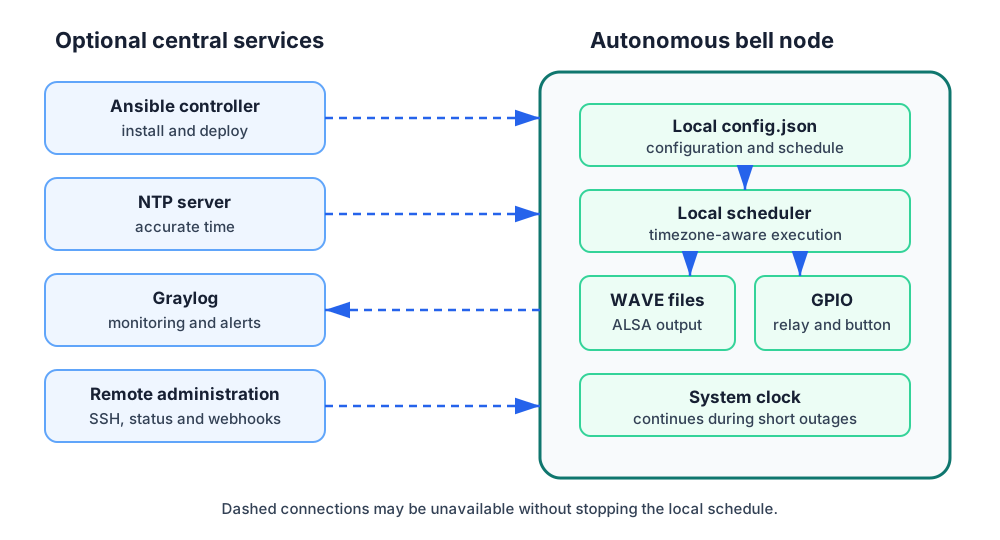
Central services support deployment and visibility. The local scheduler, configuration, audio and GPIO remain on every bell node.
Autonomous operation
The schedule is loaded from local configuration when School Bell starts. Jobs are evaluated by the local process using the configured timezone. Playback and GPIO activation use local resources. A permanent connection to an Ansible controller, Graylog server, cloud service or other bell is not required.
If central connectivity is lost, a running and correctly configured node keeps following the schedule it already loaded. Configuration changes made centrally do not take effect until they have been deployed to the node and the service has loaded them.
Local runtime requirements
Normal scheduled operation depends on:
a running School Bell service;
a valid local configuration and schedule;
available local WAVE files;
a sufficiently accurate system clock;
working ALSA and GPIO devices when configured.
Central capabilities
Central services add management and visibility, but are separate from the local scheduling path:
Ansible installs software and deploys configuration;
syslog or Graylog receives structured events;
HTTP status endpoints expose current node health;
SSH and webhooks can trigger or coordinate bells;
administrators can run diagnostics and maintenance remotely.
Failure boundaries
Remote monitoring failures do not stop local scheduling. A failed remote manual trigger does not change the result of its local bell action. Failed OpenHolidays or disable-calendar refreshes are handled without making the schedule depend permanently on those services. See Networking and time synchronization for the exact outage behavior and limitations.
Service lifecycle
At startup School Bell parses the original JSON, calculates revision hashes, validates and normalizes the configuration with Pydantic, and only then initializes runtime components. Runtime-only values such as debug flags and hashes are not configuration input.
The process stores its active schedule in memory. Editing the JSON file alone does not reload it; validate the file and restart the service deliberately.